AI product design studio · Philadelphia

Most companies bought AI.
Almost nobody designed it.

Hartzell Design is senior product design for teams putting AI in front of real users — newly funded startups that need a designer before they can hire one, and financial and professional services firms that need AI their people will actually open. Strategy, design, build, and launch, from one person who spent fourteen years shipping software inside a Fortune 500 financial firm.

Four teardowns a month, 48-hour turnaround. No pitch, no call required.

general-purpose-assistant

summarize which of my client accounts need attention this quarter

Certainly! To help identify which client accounts may need attention, I'd generally recommend reviewing several key factors. Consider looking at accounts with declining balances, reduced contact frequency, upcoming life events, or shifts in risk tolerance. You may also want to segment by…

ok but which ones

Same model. Same data. One of these gets opened on a Monday morning; the other gets closed.

00 / Who it's for

Two kinds of teams call. Same problem underneath.

Newly funded AI startups

You raised, the model works, and the product still feels like a demo. You need someone senior to shape the first real version — onboarding, the core workflow, the moments where the AI has to earn trust — before you've hired a design team, or while you're still looking for one. I can start inside two weeks, work in your stack and your Figma, and hand everything over clean when your first designer arrives.

Usually starts with: a Teardown, then Sprint Zero, then a Build Sprint.

Financial & professional services firms

You bought the licenses. Adoption stalled somewhere between the pilot and the people who'd actually use it. I've spent fourteen years in an industry where a bad interface becomes a compliance finding, so the work here is shaped around real decisions, real records, and the review steps you can't skip.

Usually starts with: a Teardown, then Sprint Zero.

If you're somewhere in between — a fintech, a wealth-tech platform, an AI company selling into regulated buyers — that's the sweet spot.

01 / The gap

Adoption is finished. Usefulness hasn't started.

Nearly every business you compete with has AI now. A subscription, a chatbot on the site, a few people quietly pasting things into a prompt box. What almost none of them have is AI that anyone depends on to do their actual job.

That gap isn't a model problem or a budget problem. It's a design problem. AI keeps arriving as a tool — a blank box, a raw capability, a workflow that breaks in week three — when what a team can actually use is a product: something shaped around a real decision, with the judgment already built in.

Closing that gap is the whole job here.

A capability nobody opens is worth exactly nothing.

Seed–Series B AI startups and financial and professional services firms

AI design that people actually adopt, from a designer with 14 years inside a Fortune 500 financial firm.

A startup whose product still feels like a demo, or a firm whose licenses never became a tool anyone opens. Same design problem.

02 / What we do

Build the thing. Then get it used.

Three services, in the order they actually happen. The campaign work is always downstream of something real — this studio doesn't sell social media management.

Product

The AI-powered tool, workflow, or interface your team will open every day. Researched, designed, built, shipped, and documented — not prototyped and abandoned.

Research · UX · UI · front-end · integration

Launch

Positioning, the landing experience, and motion work that earns attention — plus a content system your team can keep running after I'm gone. Adoption is a campaign, whether the audience is customers or your own staff.

Positioning · web · motion · ad creative

Enablement

A working session that leaves your team using AI on their real files, in their real workflow — the difference between a tool everyone has and one anyone uses.

Workshops · playbooks · internal rollout

03 / Why here

The field is crowded. Three things separate this studio.

Product judgment, not prompt tricks

Fourteen years as a senior UX strategist and technical product owner in regulated financial services — currently running the enterprise demo and sales platform its teams use daily. I know what compliance kills, what users abandon, and what actually ships. Most of this field is learning that on a client's money.

Craft that can't be generated

Interaction design, animation, and motion — the part of the work that signals a person who is good at this made this. In a market filling with generated sameness, it's the fastest trust you can buy, and it's the discipline most consultancies quietly don't have.

One person, whole job

Strategy through launch without briefing three vendors or reconciling their deliverables. AI does the labor here so the judgment stays senior — which is why an engagement costs what a mid-level contractor does and produces what a team used to.

04 / Engagements

Fixed scope. Published prices.

The path is a free Teardown, then Sprint Zero, then a Build Sprint. Most people stop at the first step that proves useful. Nothing here requires a discovery call to get a number. Launch Campaign, Working Session, and Studio Partner are add-ons or later options. Startups between design hires often use a Build Sprint and Studio Partner as a bridge — senior output now, a clean handoff later.

The path

00
Teardown
48 hours
An eight-minute recorded walkthrough of your business: three places AI would move a number that matters, and one designed mock of the best of them.
Free4 per month
01
Sprint Zero
2 weeks

A working session, a prioritized opportunity map, and a clickable prototype of the top idea. You leave with something you can put in front of your team, not a roadmap deck.

  1. Week 1. Working session and a prioritized opportunity map.
  2. Week 2. Clickable prototype of the top idea.

Sprint Zero fee is credited toward a Build Sprint if you continue within 30 days.

$4,500fixed
02
Build Sprint
4–8 weeks
One AI-powered product, tool, or workflow — designed, built, integrated, shipped, and handed over with documentation your team can maintain.
$15–35Kby scope

Add-ons and later

03
Launch Campaign
3–5 weeks
Positioning, landing experience, motion and video assets, and a content system your team runs themselves. Built to make the thing in 02 get opened.
$9–18Kby scope
04
Studio Partner
Quarterly
Ongoing product iteration and campaign cycles, with a written maintenance response time. The thing that breaks in week three gets fixed the same day.
$4.5–9Kper month
05
Working Session
One day
A half-day with your team on their real files: what to use, what to ignore, and how to build it into the job they already have. Taught, not demoed.
$4–7.5Kper session

05 / On the bench

The studio is new. Here's what's on the bench.

No invented case studies and no logo wall. These are the pieces in progress right now — you can judge the work by them, or by the teardown, which costs you nothing.

Gamified sales demo platform

A prototype of a two-sided demo experience: a buyer-facing walkthrough that adapts to who's watching, and a seller-facing view that tracks what reps actually use. Built from fourteen years of running the real thing at enterprise scale.

Product · prototype · game mechanics
In build

Client review concept — independent wealth firm

An end-to-end design for what an advisory firm's quarterly book review looks like when AI is shaped as a product rather than bolted on. The hero panel at the top of this page is one screen from it.

Product design · financial services
In design

This site

Positioning, copy, design, motion, and build — start to finish, by the same person who'd do yours. If it reads like a template, that's a fair reason not to call.

Positioning · web · motion
Shipped

06 / Labs

Labs

Working AI prototypes I build to test ideas in public. Self-initiated concepts, not client work.

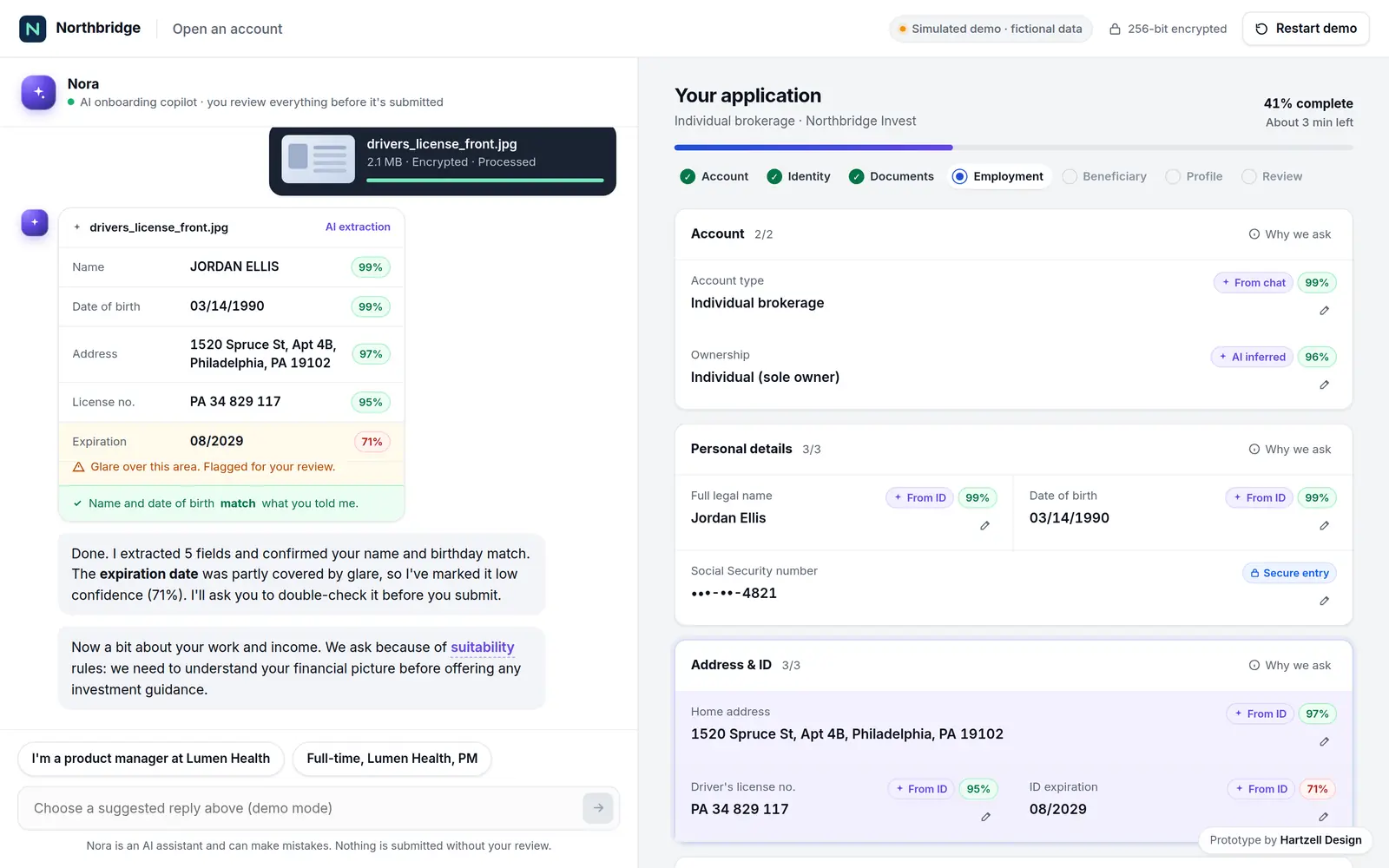
Simulated Northbridge demo: the copilot Nora extracts a fictional driver's license, flags the expiration at 71 percent confidence because of glare, and fills the brokerage application beside the chat. Labeled a simulated demo with fictional data. Prototype by Hartzell Design.
Self-initiated concept

AI onboarding copilot

Not client work. Northbridge, the brokerage in the demo, is a fictional brand.

The problem

Opening an account here is a long application: account type, identity, address and ID, work and income, an optional beneficiary, and an investment profile. The prototype explores what happens when that form becomes a guided conversation, and a person still has to review it before anything is submitted.

The approach

Nora, the copilot, talks on one side. The application fills in on the other. The demo takes suggested replies only. Each filled field is marked with its source — the chat, an inference, an ID, a pay stub, or a secure entry — and a confidence score when the copilot supplied it. A low-confidence value is flagged for the person to confirm or edit. A few terms, including Know Your Customer and suitability, open a plain-language note labeled not financial advice. Nothing is submitted until a person reviews it.

What the demo shows

Fictional data, and the page says so. You pick an account type. Nora fills the application from the conversation and from two documents, a driver's license and a pay stub, with a confidence score on each extracted field. The license expiration is shown at 71% because of glare and held for you to confirm or edit. The Social Security number goes into a masked field and is not repeated in the conversation. The submit button stays off until that flag is resolved and the attestation is checked.

View the prototype

07 / Studio

One designer who does the whole job.

I'm Chris Hartzell. For fourteen years I've designed and shipped digital products inside a Fortune 500 financial firm — as a senior UX strategist and a technical product owner, which is an unusual pair of hats and the reason this works. I've spent that time leading an enterprise demo and sales platform, which means I've watched, at close range, what makes internal software get adopted and what makes it get ignored.

I taught graduate UX and product strategy for two years, which is why the workshops are good. I've worked in animation and game design, which is why the work moves. And I've spent my career in an industry where "move fast and break things" gets you a regulatory finding, which is why I'm careful with the parts that matter.

Hartzell Design is the studio version of that. Small on purpose — you work with me, not an account manager.

Before the studio

  • 14 years at a Fortune 500 financial firm, from UI developer to Senior UX Strategist & Technical Product Owner.
  • Led the firm's first Apple Vision Pro experience.
  • Led the enterprise sales demo platform used in multimillion-dollar institutional finals.
  • Led 10+ UX designers across consultant-facing, trading, and secure-login products.
  • Prototyped an Apple Watch app with Claude Code that now demos to clients.
  • Taught graduate UX & product strategy at Jefferson University (2023–2025); 40+ thesis students mentored.
Based
Philadelphia, PA
Founded
2026
Team
One, deliberately
Depth
Financial & professional services
Also serving
Seed–Series B AI startups
Engagements
Remote & Philadelphia-area

08 / Start

Let me show you the gap in your business first.

Tell me what your team does. You'll get an eight-minute teardown back within 48 hours: three specific opportunities and one designed mock. No call, no deck, no obligation — if it's useful, we'll talk about Sprint Zero.

Four a month, first come. Now booking teardowns.

Rather talk first? Book a 30-minute call → · LinkedIn → · chris@hartzell.design

AI product design studio · Philadelphia